
Reconnecting the Education System to Life.
As a whole generation grows up disconnected from themselves, others, and the Earth, it is essential to address the physical, mental, and ecological challenges that arise. There is an urgent need to unlearn and reimagine any system we have created as humans, especially the most fundamental and life-forming system; the education system. We need to transition towards an empowering education ecosystem. By embracing social connections, ecological solutions, and economic transformation, we can create a future where communities can thrive and contribute to a sustainable planet. Where do we start in creating a healthy, flourishing, and holistic future for all?


@nowschool
Part 01 - Start with asking the right questions.
The most fundamental problem in the education system can be summarized as a lack of adaptability and relevance. The traditional education model often focuses on standardized curricula, rigid structures, and outdated teaching methods that fail to meet the diverse needs and changing demands of students and society. This results in a disconnect between what students learn in schools and the skills, knowledge, and experiences they require to thrive in the real world. Additionally, the emphasis on standardized testing and academic performance often overlooks the holistic development of individuals, neglecting crucial aspects such as social-emotional skills, critical thinking, creativity, and practical application of knowledge. The education system needs to evolve to become more flexible, human-centred, and aligned with the needs of the 21st century, empowering learners to become adaptable, lifelong learners capable of navigating an ever-changing world.
Every transformation and transition in systems starts with asking the right questions. When it comes to reimagining and improving our education system, it is essential to reflect on its fundamental aspects. By asking ourselves five fundamental questions, we can ignite a powerful dialogue and set the stage for meaningful change. What is the purpose of education? Why are schools designed the way they are? Is our education system inclusive and equitable? Does our education system foster creativity and critical thinking? Are we fostering holistic development? These fundamental questions are the stepping stones towards reimagining education. They prompt us to challenge the status quo and envision a future-oriented, inclusive, and holistic approach to education. By asking these questions, we open up possibilities for transformative change and pave the way for an education system that empowers and inspires learners to reach their full potential.
Part 02 - Essential pillars: ecological, economic, and social
As we navigate the challenges and complexities of the modern world, it becomes increasingly clear that our education system requires a fundamental transformation. To redesign the education system, we should embrace three essential pillars: ecological, economic, and social. These pillars hold profound meaning, for they are not merely abstract concepts, but rather the guiding principles rooted in the very essence of permaculture. These pillars provide a framework for reimagining education and addressing the pressing challenges we face. Permaculture teaches us to honour and embody sustainable and regenerative practices, and by infusing these pillars into our educational vision, we have the power to cultivate a system that deeply nourishes both individuals and the planet. It is through this integration that we create an environment that fosters a beautiful dance of interconnectedness and harmony between us, as humans and the natural world that surrounds us.
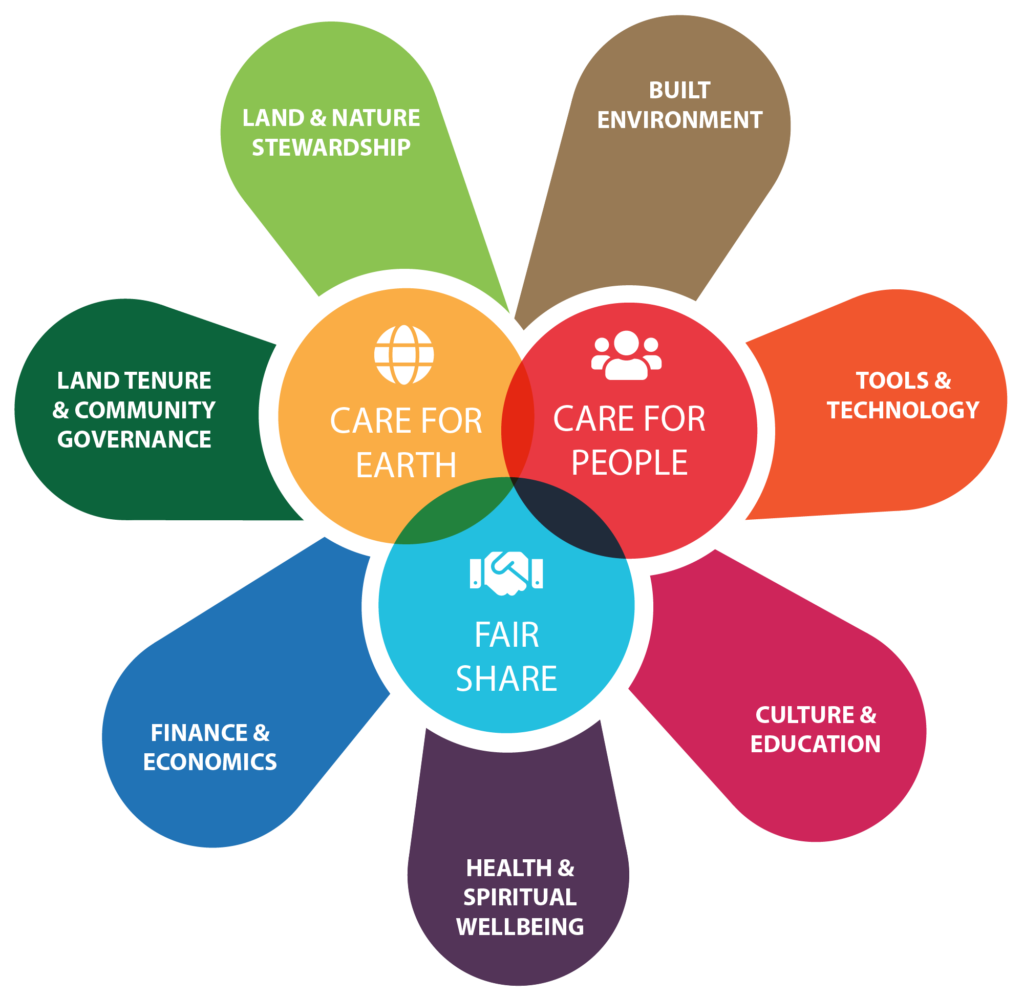

By Angela de Vlaming - @nowschool
CARE FOR EARTH
The first pillar, ecological balance, recognizes the critical importance of our relationship with the natural world. It emphasizes the need to design and create systems that work in harmony with nature, rather than exploiting or depleting it. Ecological sustainability in permaculture involves observing and understanding the patterns and processes of natural ecosystems and applying those principles to the design of our human systems.
The ecological pillar encourages us to cultivate a deep connection with the Earth and its living systems. It invites us to recognize that we are part of nature, not separate from it. By integrating ecological principles into our education system, we can foster a sense of awe, reverence, and responsibility for the natural world in students. This pillar emphasizes hands-on experiences, outdoor education, and a curriculum that highlights the interconnections between humans and the environment.
CARE FOR PEOPLE
The second pillar, social empowerment, recognizes the importance of nurturing meaningful connections, empathy, and collaboration within our communities. Permaculture understands that true sustainability cannot be achieved without a society that values inclusivity, compassion, and social well-being.
Social empowerment in permaculture involves cultivating self-awareness, emotional intelligence, and a sense of purpose in individuals. It promotes inclusive education, participatory decision-making, and the development of skills for effective communication and conflict resolution. By integrating social empowerment into the education system, we can foster a generation of empathetic, resilient, and socially conscious individuals who can actively contribute to positive change in their communities and the world.
FAIR SHARE
The third pillar, economic transformation, challenges the prevailing economic paradigm that prioritizes endless growth and profit at the expense of social and environmental well-being. Permaculture encourages us to question the assumptions and practices of the current economic system and explore alternative models that prioritize sustainability, equity, and resilience.
Economical transformation in permaculture involves shifting towards regenerative practices, embracing local economies, and prioritizing fair trade and ethical business practices. It encourages us to consider the true costs and impacts of our choices, both economically and ecologically. Within the education system, this pillar calls for teaching students about the principles of sustainable economics, inspiring them to think critically about consumption patterns, and empowering them to envision and create a more just and sustainable economy.
The essential permaculture pillars of ecological, economic, and social have emerged from years of observation, experimentation, and practical application. They are based on the understanding that our current systems are not serving us or the planet adequately. Permaculture offers a holistic and integrated approach to addressing the interconnected challenges we face, recognizing that ecological, economic, and social dimensions are deeply intertwined.
By integrating these three pillars – ecological, economical, and social – into the design of our education system, we create a transformative learning experience that prepares individuals for a sustainable and interconnected future. This holistic approach enables children to develop a deep understanding of their role in creating a more regenerative and harmonious world. It empowers them to become lifelong learners, critical thinkers, and responsible global citizens who actively contribute to shaping a brighter and more sustainable future for all.

By Angela de Vlaming - @nowschool

By Angela de Vlaming - @nowschool
Part 02 - Facing Challenges and Finding Solutions
Facing Ecological challenges: We also see these challenges reflected in the outside world. Nature is under pressure, becoming increasingly depleted. Extreme heat, climate migration, global warming, drastic loss of biodiversity, and our food, which lacks the necessary nutrients and vitamins to keep us healthy and vital, all contribute to an unsustainable planet. We are heading towards an uninhabitable Earth because we continue to do what we have been "taught." What and how we learn determines every aspect of how we live and what we do. We are part of nature, and everything is interconnected. However, we have disconnected ourselves from nature, with all the consequences that follow.
Finding Ecological solutions: To address ecological challenges, we must embark on a transformative journey towards sustainable practices. It starts with recognizing our interconnectedness with the natural world and shifting our mindset from exploitation to stewardship. By embracing regenerative agriculture, renewable energy sources, conservation efforts, and responsible consumption, we can restore the balance between humans and nature. Protecting biodiversity, restoring ecosystems, and prioritizing sustainable development pave the way for a harmonious coexistence with the Earth.
Facing Social challenges: A whole generation is growing up disconnected from themselves, others, and the Earth. As a result, various physical and mental challenges are increasingly manifesting at a young age. Children feel unhappy, experience stress, and loneliness, struggle to connect with their emotions, and often do not know what they want in life. They are distanced from nature, perceiving themselves as separate from it, and due to conditioning, our environment, upbringing, and society, they become trapped within themselves.
Finding Social solutions: The solution lies in fostering connections - connections with ourselves, with others, and with the Earth. By cultivating self-awareness, emotional intelligence, and empathy, we can bridge the gap between individuals and create a society grounded in understanding and compassion. Through inclusive education, nurturing relationships, and promoting mindfulness, we empower future generations to develop a deep sense of purpose, emotional well-being, and the ability to forge meaningful connections with others and nature.
Facing Economic challenges: Because the economic system remains central, we live far beyond the Earth's carrying capacity and our own body's capacity: the economy drains us. Endless growth at the expense of everything that life offers seems to be the only option. This prioritization of economic profit over social and ecological well-being persists, instead of working hand in hand. The current one-sided economical system means that by 2050, we will need a staggering five Earths. But this is a future scenario that we can rewrite ourselves.
Finding Economic solutions: Economic transformation is crucial for a flourishing future. We need an economic system that prioritizes well-being, equity, and planetary health. Transitioning towards a circular economy, where resources are used efficiently and waste is minimized, reduces our ecological footprint. Embracing ethical business practices, fair trade, and investing in green technologies drives sustainable innovation and social progress. By redefining success beyond mere financial gains and valuing the holistic well-being of individuals and the planet, we can create an economy that serves the greater good.

By Angela de Vlaming - @nowschool
“All these challenges stem from old systems that no longer serve us or contribute to a healthy, thriving, and holistic future that we all deeply yearn for.”
By fostering these core principles, and redefining our priorities, we can forge a path towards a healthy, flourishing, and holistic future that fulfils the deepest aspirations of us all. By unlearning outdated systems and embracing a holistic approach, we can pave the way towards an empowering education ecosystem. Together, we can create a brighter future for generations to come.


© Juliette Schraauwers, All Rights Reserved. This content is intended for personal use only and cannot be distributed, reproduced, or sold without explicit permission from the copyright holder.

I believe we have to Rethink, Relearn, Reimagine and Regenerate what we know, in order to Thrive in Today’s World - I’m really glad you’re here. Because I’ve combined it all into one place for parents, caretakers, and school makers to empower the next generation to grow up as holistic thinkers & doers.
We often ask ourselves: Why didn't we learn this in school? The Eco Home ToolKid is designed to help you empower children to grow up as holistic thinkers and doers. We have the tools & training in place you'll need to rethink, relearn and reimagine life. Our goal is for you to guide children on their unique journey in order to thrive in this world. Including 74 pages!
My mission is to create healthy and healing spaces for our loved ones. Whether building new or transforming your current home, this TOOLKiD empowers you every step of the way. I understand the profound impact of the environment on our children's well-being. And I believe it's our duty to create healthier homes.
In today's world, it is crucial to prioritize sustainable and toxic-free living spaces. This TOOLKiD provides insights into constructing an ecological home with natural materials, fostering a deep connection with nature and responsibility towards the environment. Discover practical methods to incorporate natural materials, energy efficiency, and eco-conscious practices into your home. This TOOLKiD guides you in creating an environment that supports physical health, mental well-being, and connection to the natural world.
What is in the 74 pages ToolKiD:
Introduction
Why Do We Build This Way?
Top 20 Toxins in Homes
Ecological v.s. Toxic Homes
Building Material Swap
Household Items Swap
My Personal Journey
Get Children Involved
Finding Land to Build
Local Building Regulations
Finding inspiration
What is Biophilia?
Building Options
3 questions to ask yourself
Some Thoughts on Mortgage
Behind the Scenes
Envision your future home
Make it visual
Layout your floor plan
Behind the Scenes
Rest and Recharge
What is Feng Shui?
Playing with colours
The power of plants
Biobased inspiration
Sourcing Biobased materials
Circular inspiration
Sourcing Circular Materials
DIY or Contractor?
Behind the Scenes
Building New Planner
Renovation Planner
Why we choose wood
Wood Checklist
Behind the Scenes
My 12 Favourite Materials
Grow your Eatable Garden
The End Result
Overcoming challenges
Conclusion
All Tools & Training